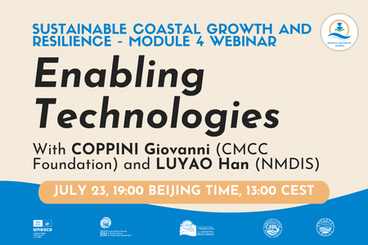
Co-Growth Module 4 Webinar – Enabling Technologies
With Giovanni Coppini (CMCC Foundation) and Han Luyao (National Marine Data and Information Service – NMDIS)
-
Date: 23 JULY 2026 from 13:00 to 15:00
-
Event location: Online event
-
Type: Webinars
Webinar Overview
As part of the second edition of the Sustainable Coastal Growth and Resilience (Co-Growth) course, Module 4 explores the enabling technologies that are transforming coastal resilience research and operational services.
The webinar brings together experts from Europe and Asia to discuss how artificial intelligence, cloud computing, and big data are reshaping the way coastal information is collected, analysed, and transformed into decision-support tools. Participants will gain insights into innovative digital approaches that support coastal monitoring, forecasting, marine disaster prevention, and climate adaptation.
The session highlights the growing role of Digital Twins, AI-powered applications, and interoperable data infrastructures in strengthening coastal resilience and supporting evidence-based decision-making for vulnerable coastal communities.
Speaker 1
Giovanni Coppini
CMCC Foundation
Title
AI and Cloud-Based Solutions for Coastal Resilience
Abstract
This presentation examines how cloud-native applications and AI-powered workflows can strengthen coastal resilience by integrating heterogeneous coastal observations, numerical models, and advanced data analytics. It discusses scalable approaches for developing Digital Twins of the Coastal Ocean, supporting what-if scenario analysis and decision-making by transforming fragmented coastal data into operational knowledge for risk reduction and climate adaptation.
Biography
Giovanni Coppini is Principal Scientist at the CMCC Foundation and Director of the Strategic Program Global Coasts as a New Frontier. With more than twenty years of experience in operational oceanography, he leads international initiatives on coastal observation, prediction, climate services, Digital Twins, and resilience solutions for vulnerable coastal communities, particularly in the Global South.
Speaker 2
Han Luyao
National Marine Data and Information Service (NMDIS)
Title
Exploration and Practice of Applying DeepSeek to Marine Disaster Prevention and Control Along China's Coast
Abstract
This presentation introduces the application of DeepSeek-R1, a large language model designed to support marine disaster prevention and management along China's coastline. By integrating heterogeneous data sources, the system enhances disaster monitoring and forecasting for hazards such as storm surges, tsunamis, ocean waves, and harmful algal blooms. The presentation also illustrates how artificial intelligence can support quantitative risk assessment, emergency response planning, and post-disaster recovery through tailored decision-support solutions.
Biography
Han Luyao is a Senior Engineer at the National Marine Data and Information Service (NMDIS), where she has worked since 2013. Her activities focus on marine digital infrastructure, marine data services, international cooperation platforms, and marine big data technologies. She applies artificial intelligence and advanced data management techniques to improve marine data interoperability, processing, and operational services.