The COMPASS Course Launches as Part of the DCC-CR Coastal Resilience School: Strengthening Coastal Resilience in the Philippines

Advanced training to enhance coastal resilience, the COMPASS Course equips professionals with tools for climate services, risk assessment, and sustainable adaptation strategies.
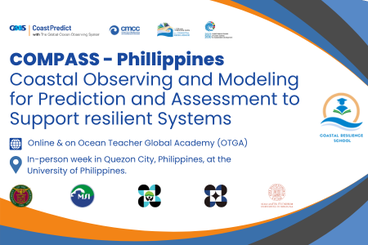
  • Date:

    24 FEBRUARY
    -
    08 MARCH 2025
     
  • Event location: In presence and online event

  • Type: Courses

The COMPASS Course (Coastal and Marine Climate Services for Sustainable Adaptation Strategies), organized by CoastPredict, is an advanced training program designed to equip professionals with the knowledge and tools to strengthen coastal resilience in the face of climate change.
This is the second training program launched by the DCC-CR’s Coastal Resilience School, reflecting its commitment to capacity-building and knowledge-sharing to support coastal communities worldwide.

Developed in collaboration with the SUSTAIN project (a UN-endorsed initiative affiliated with CoastPredict), the CMCC Foundation – Euro-Mediterranean Centre on Climate Change, and the DCC-CR, this blended learning course focuses on the Philippines region. Its in-person component will be held at the University of the Philippines, Quezon City.

Hosted on the Ocean Teacher Global Academy platform, the course offers participants key insights into risk assessment, adaptation planning, and policy integration.

Course Overview

The training was conducted in two phases:

Online Sessions (24 & 26 February 2025 –  held on OTGA):

Participants were introduced to the Relocatable Ocean Platform SURF, the fundamentals of coastal wave modeling, and the principles of coupled physical-biological numerical modeling of marine biogeochemical cycles. They also learned how to access and use the Interactive Computing Service on CINECA’s High-Performance Computing system. The online training concluded with a step-by-step tutorial on executing a downscaling experiment with SURF-NEMO. These lessons provided the foundational knowledge necessary for the in-person sessions.

In-Person Training (3–8 March 2025, University of the Philippines Diliman):

The intensive in-person week consisted of six-hour daily sessions, featuring advanced numerical modeling applications, hands-on exercises, and real-world case studies conducted on CINECA high-performance computing systems. The training also included demonstrations of decision-support tools, such as WITOIL for oil spill response and VISIR-II for optimizing vessel routes, equipping participants with practical skills for marine hazard management.

Participants engaged in hands-on training sessions utilizing advanced modeling tools including the SURF-NEMO platform for ocean circulation modeling, WAVEWATCH III for wave dynamics, and the BFM (Biogeochemical Flux Model) for marine ecosystem simulations. Additionally, they applied machine learning clustering algorithms to analyze long-term datasets of chlorophyll and sea surface temperature (SST) anomalies, gaining insights into environmental variability and ecosystem dynamics.

The course concluded with participant presentations, where they showcased case studies across various coastal regions in the Philippines, including Lingayen Gulf, the Bolinao-Anda Reef, the Sulu Sea, and the San Bernardino Strait. Participants analyzed circulation dynamics, highlighting key findings and the benefits of high-resolution models in capturing small-scale features.

Field Activity – Installation of InterBox:

As part of the hands-on training, participants took part in the installation of an InterBox, a low-cost sea level sensor, developed and provided by CMCC, at the Tide station at Manila South Harbor, gaining practical experience in coastal observation and monitoring. 

Key topics covered:

  • Downscaling experiments using the SURF platform
  • Advanced AI modeling for coastal prediction
  • Remote sensing applications for marine monitoring
  • Biogeochemical and wave modeling techniques
  • Decision-support systems for coastal resilience

A detailed course schedule can be found here